When the Evidence speaks – the Investigation as Accident Analyst begins
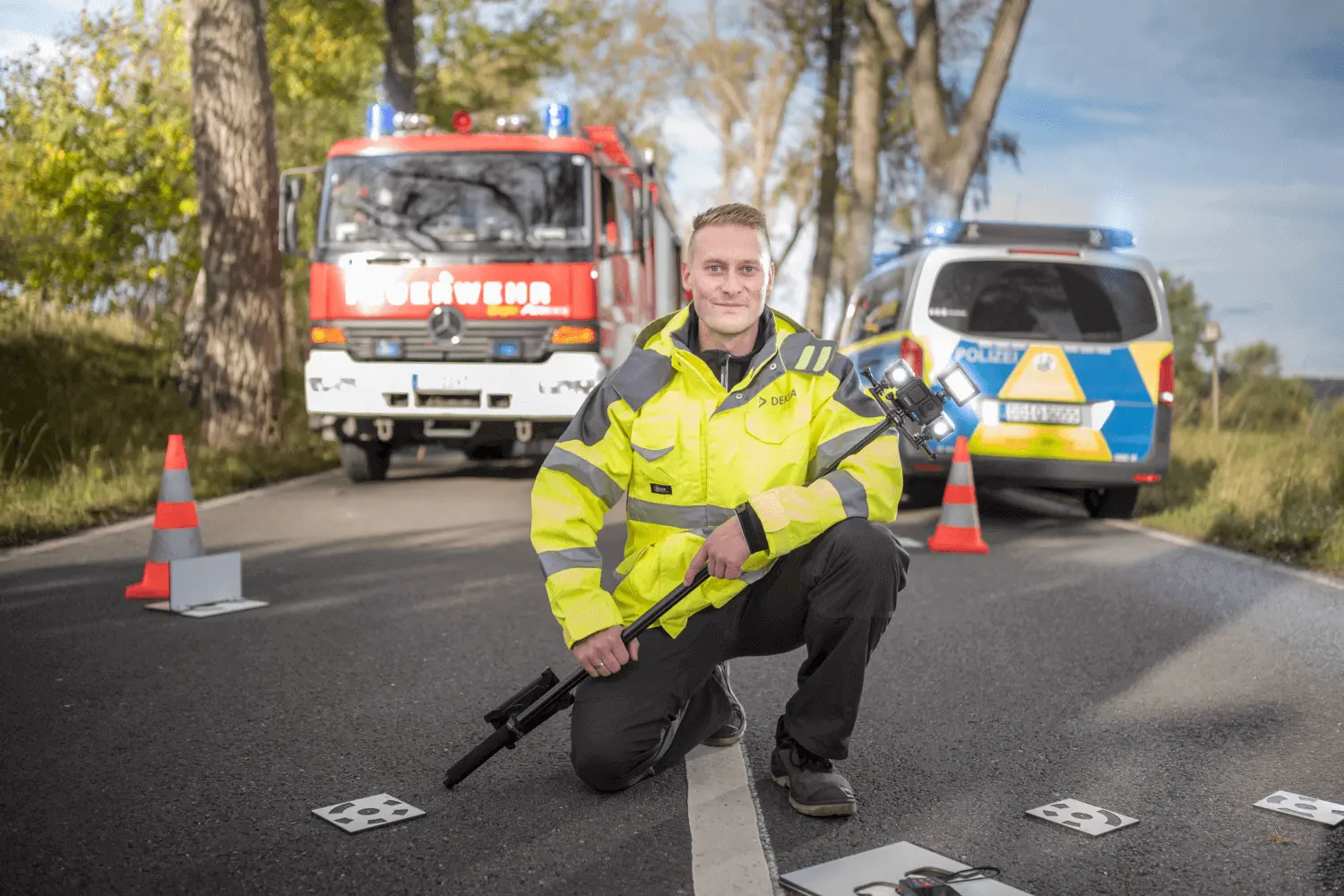
When the experts from DEKRA Accident Analysis arrive at the scene of an accident, the fire department and police are still there. Even before the wreckage is cleared away, the accident analysts’ real work begins. They document the scene from every angle: the position of the vehicles, skid marks, debris fields, and damage to guardrails or trees. Every little detail can become important later. A position shifted by just a few centimeters, a tiny scratch on a wheel, a seemingly insignificant mark on the road shoulder—all of these are pieces of the puzzle that come together to form a coherent picture of the accident. Whether it’s a nighttime collision on a country road or a complex crash involving multiple road users in city traffic, the goal is always to reconstruct the events as objectively as possible—without assigning blame, but with maximum precision.
In the past, accident reconstruction relied almost exclusively on measuring tapes, sketch pads, and individual photos. Today, analysts also use digital tools: high-resolution photo documentation, 3D measurements of the accident scene, and specialized software that can calculate speeds or braking maneuvers.
The collected data is used to create a virtual replica of the accident on the screen. Vehicles are positioned as 3D models at precise distances from one another, and roadways and obstacles are recreated. This makes it possible to simulate how the vehicles might have been moving before the crash—and to determine which scenarios are physically possible and which are not.
Between Forensics and Prevention – How Accident Analyses Are Used
The work of accident analysts does not end with the final report. Many findings are incorporated into broader evaluations – such as accident research, safety studies, or the further development of vehicle testing programs. When certain accident patterns recur, it serves as a warning sign: Perhaps an intersection has poor visibility, signage is confusing, or a specific vehicle configuration is particularly prone to accidents. In such cases, manufacturers, authorities, or infrastructure managers can take targeted corrective action.
For people affected by an accident, the situation is often emotionally charged and difficult to grasp. The neutral reports from DEKRA accident analysts provide transparency and clarity: How did the crash happen? How could it have been prevented? What factors played a role? What can be clearly proven, and what cannot?
In this way, the experts are not only investigators but also interpreters: they translate complex physical relationships into a language that courts, insurers, and those affected can understand - thus helping to ensure that decisions are made on a sound basis.